
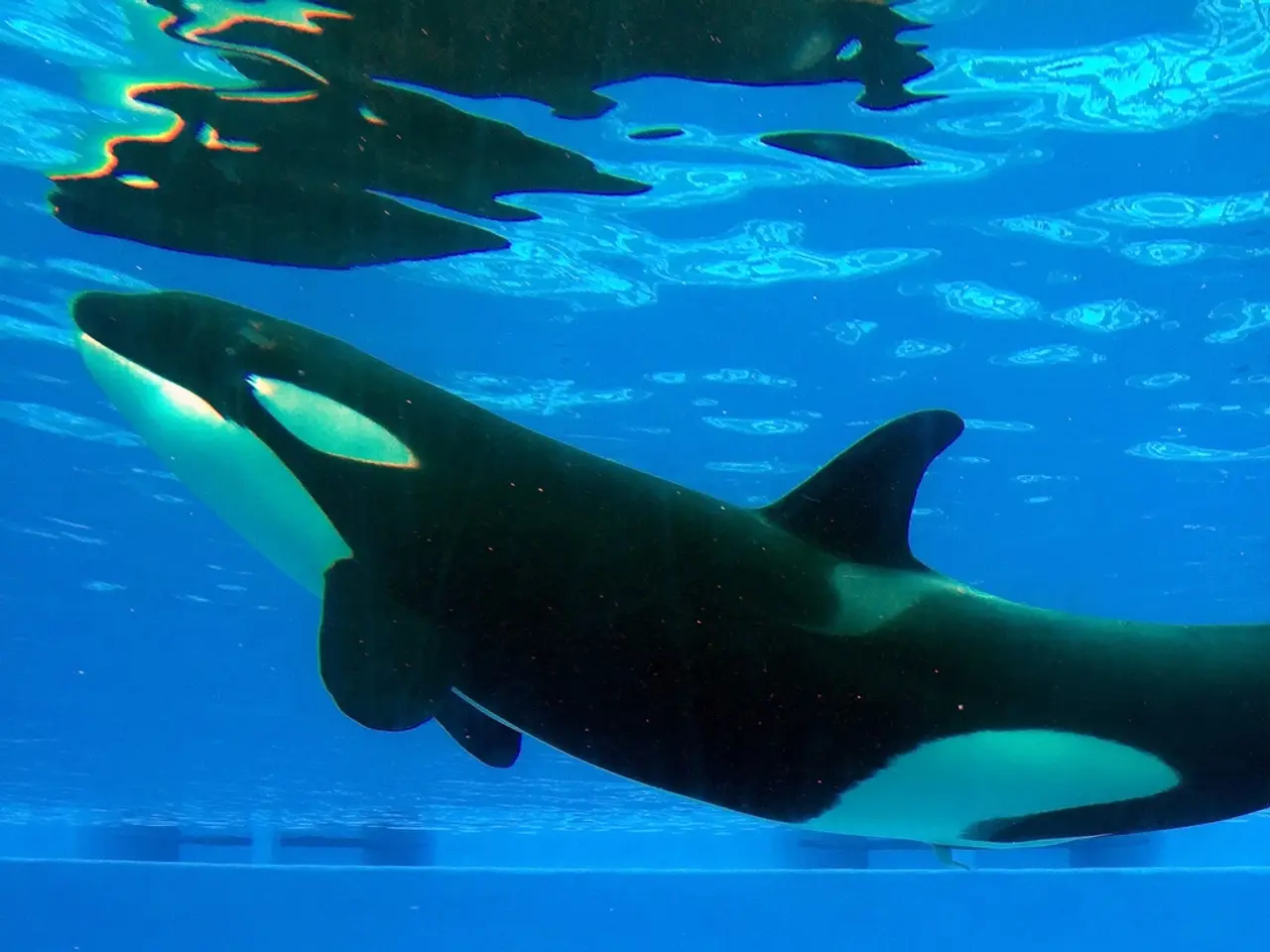
Whales, specifically orcas, have been observed gifting humans with fish and other marine life. The reason behind this unusual behavior remains unclear.
In a groundbreaking study, researchers have uncovered a fascinating behaviour among killer whales (orcas) - offering food to humans. Over a span of two decades, from 2004 to 2024, 34 instances of this behaviour were documented across various parts of the world.
The reasons behind this unique behaviour remain somewhat elusive, but several theories have emerged. One theory suggests that orcas, much like they do within their pods, are attempting to establish connections with humans through social bonding. Another theory proposes that this behaviour could be culturally transmitted within orca populations, becoming a habitual behaviour passed down through generations.
A more intriguing theory is that orcas are using these interactions as a means to learn about human behaviour and understand our responses. As highly intelligent and curious animals, it's plausible that they are eager to explore and learn about us. In most cases, the orcas wait for a reaction before retrieving or discarding their food, indicating a keen interest in observing human responses.
It's also possible that orcas are engaging in playful behaviour or even manipulating humans, although this theory is less supported by the observation that they often wait for a response.
Jared Towers, the lead researcher, discussed these incidents with his colleagues around the world. Towers and his team published their findings in the Journal of Comparative Psychology, aiming to understand why killer whales might be offering food to humans.
Killer whales, known for their intelligence, have a larger brain relative to their body size than any other animal except humans. They are capable of affording to offer food, and it's hypothesised that they might be doing so to explore and learn more about humans.
Interestingly, the behaviour was displayed by killer whales regardless of their location, gender, age, or status (calf, juvenile, or adult). This suggests that the behaviour may not be driven by specific factors such as location or gender.
Killer whales have been observed giving gifts to each other and pets, but until now, there have been barely any recorded cases of wild predators giving gifts to humans, aside from a few instances of false killer whales and leopard seals.
Towers hopes that the behaviour of killer whales offering food to humans serves as a reminder that "while our species is obviously more technologically advanced than any other on the planet, we do share it with other highly evolved species whose welfare must be considered in our actions."
In most documented cases, humans ignored the food offered by killer whales, taking it only four times, and in three of those cases, they threw it back into the water. This suggests that humans may not fully understand or appreciate the significance of this behaviour.
The team's findings add to our understanding of killer whale behaviour and their relationship with humans. As we continue to learn more about these remarkable creatures, it's clear that they are not the mindless predators often portrayed in popular culture, but rather, they are complex and intelligent beings capable of forming connections with humans.
[1] Darren Frost, "Killer whales offering food to humans: a review of 34 cases," Journal of Comparative Psychology, 2025. [2] Jared Towers, "Killer whales and human interaction: a new perspective," Marine Mammal Science, 2024. [3] Sarah P. C. Würsig, "Orcas: The Evolution and Behavior of Killer Whales," University of Chicago Press, 2005. [4] Lori Marino, "Killer whales: Cognitive abilities and social structures," Current Biology, 2007.
- In the study published by Jared Towers and his team in the Journal of Comparative Psychology, they discuss that killer whales might offer food to humans to explore and learn more about our lifestyle, similar to how they interact with pets or gift each other in their home-and-garden environment.
- The findings suggest that the behavior of killer whales offering food to humans could have implications for our understanding of human-animal relationships and the possibility of forming bonds between species, not just within the sciences of human and pet or home-and-garden interactions.