
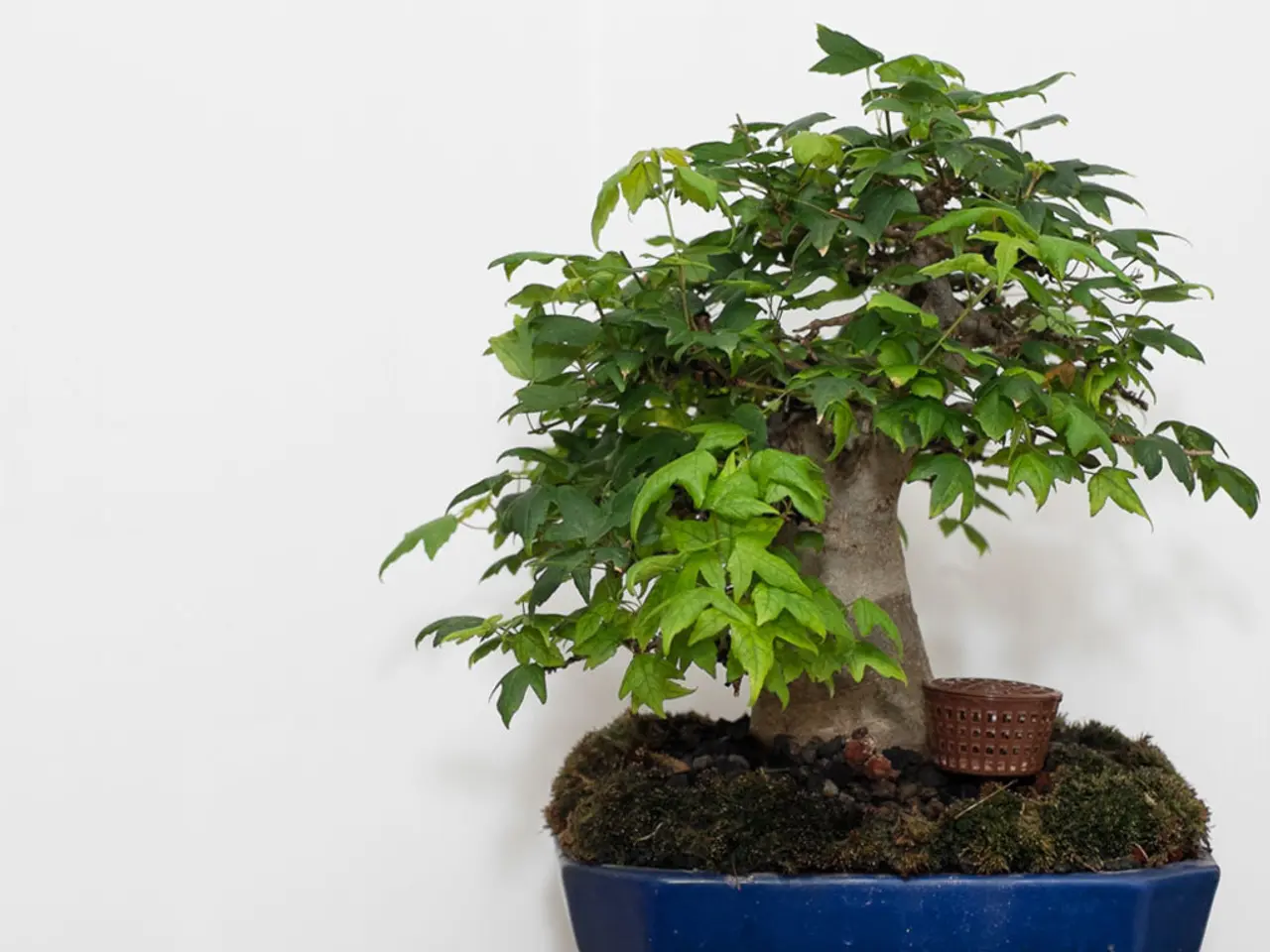
Mastering the Fundamentals and Achieving Balance in Classical Upright Bonsai (Chokkan)
Mastering Balance and Harmony in the Chokkan Style Bonsai
The art of bonsai has long been celebrated for its ability to capture the essence of nature in miniature form. One of the most iconic styles is the Chokkan, a declaration of balance and harmony in bonsai cultivation. Here's a guide to mastering the Chokkan style, also known as the Formal Upright bonsai.
Trunk Development
The foundation of a Chokkan bonsai lies in the trunk. A perfectly straight trunk with smooth tapering from the base to the apex is essential. About one-third of the trunk should be exposed from the front to maintain the formal upright aesthetic. The taper should become more distinct as the tree matures, achieved through regular removal of the growing tips and wiring to shape the apex.
Branch Placement
Branches in a Chokkan bonsai are strategically positioned to form a balanced triangle. The longest branch should be placed about one-third up the trunk, emerging squarely. The second branch is slightly higher and opposite the first. Branches taper in length ascending the trunk to form a cone shape, providing balance from all viewing angles.
Pruning and Wiring
Annual pruning of the growing tips encourages a compact silhouette and strong branch structure. Wiring new branches into place shapes the apex and further defines the taper and branch angles, maintaining harmony in form.
Back Budding and Strong Branching
Encouraging back budding through careful pruning promotes fuller, denser foliage and better branch placement for a balanced look.
Maintaining Dynamic Stability
Although formal upright, this style can benefit from slight dynamic movement by careful shaping and wiring that prevents stiffness, enhancing harmony without losing stability.
Branch Length and Angle
Primary branches should be evenly spaced for a balanced distribution of foliage, with the angle of primary branches set at 45 degrees from the trunk.
Species Considerations
Factors such as tree species, pot size, soil type, climate, and season should be considered when determining the ideal watering frequency for a bonsai.
Tree Selection and Training
Deciduous trees can also be styled as Chokkan, as seen in the Zelkova serrata bonsai created by Japanese master, Saburo Kato. The Japanese Bonsai Society found that 80% of professional bonsai artists begin their training with the Chokkan style.
Cultivating More Than Aesthetics
Cultivating a Chokkan bonsai rewards not only in the aesthetic appeal but also in the cultivation of patience, discipline, and mindfulness. The refinement process requires precision, a deep understanding of the tree's natural growth patterns, and a commitment to maintaining balance and harmony over time.
[1] Bonsai Empire [2] Bonsai Tonight [3] Bonsai4me
- To maintain the aesthetics of a Chokkan bonsai, one needs to delve into data-and-cloud-computing platforms like Bonsai Empire, Bonsai Tonight, and Bonsai4me for guides on trunk development, branch placement, pruning, wiring, and back budding.
- As one cultivates a Chokkan bonsai, they foster personal-growth and learning, undoubtedly aiding in self-development by mastering the art's intricate techniques and principles.
- Pursuing a hobby such as Chokkan bonsai can intertwine seamlessly with technology, connecting botanical enthusiasts worldwide via online fashion-and-beauty communities where they can showcase their creations and seek advice.
- opportunities for learning expand beyond horticulture, as an individual may indulge in lessons on artificial-intelligence or education-and-self-development, further pondering the harmonious balance within nature and technology.
- Reflecting on the rational design of a Chokkan bonsai, with its branches forming a balanced triangle and sleek tapering trunk, one might deduce that the ethos echoes that of a well-organized data structure in technology - efficient, harmonious, and uncluttered.



)